
05-Feb-2026 Budget 2026 Analysis | Important Tax Updates & Webinar Invitation
#unionbudget2026 #indianbudget #budget2026analysisAPMH Moores Rowland LLP presents a concise analysis of key Direct and Indirect Tax amendments introduced in Union Budget 2026, including the New Income Tax Act, MAT changes, MSME measures, investor taxation, and GST updates. Join our expert-led webinar for practical insights and implications for businesses, investors, and individuals.
Budget 2026 Analysis | Important Tax Updates & Webinar Invitation
As always, Team APMH has conducted a detailed Analysis of Important amendments in Direct & Indirect Tax proposals for businesses, investors, and individuals presented in the Union Budget.
Click here to download your soft copy now
Key Budget Highlights
The headline of this year's financial statement is the operationalisation of the New Income Tax Act, 2025, which replaces the 1961 Act effective from April 1, 2026. To ease the burden on the electronic filing system, the government has introduced a staggered return filing timeline: salaried individuals (ITR 1 & 2) will continue to file by July 31st, while non-audit business cases and trusts will now have a deadline of August 31st. Additionally, the window for filing revised returns has been extended from December 31st to March 31st.
For the corporate and business sector, the Minimum Alternate Tax (MAT) rate has been reduced from 15% to 14%, with MAT now treated as a "final tax". A significant structural change has been introduced for share buybacks, where the consideration received will now be taxed as Capital Gains in the hands of shareholders, accompanied by an additional tax on promoters to disincentivize tax arbitrage. To support MSME liquidity, it is now mandatory for CPSEs to settle purchases from MSMEs via the TReDS platform.
Investors and individuals will see changes in transaction costs and compliance relief. The Securities Transaction Tax (STT) on Futures has increased to 0.05%, while Options premium and exercise rates have risen to 0.15%. On the relief front, the TCS rate on overseas tour packages and LRS remittances for education/medical purposes has been reduced to a flat 2%. Furthermore, a one-time Foreign Assets of Small Taxpayers – Disclosure Scheme (FAST–DS 2026) has been introduced to allow the declaration of undisclosed foreign assets with immunity from prosecution.
On the indirect tax front, the Budget focuses on trade facilitation and reducing the cost of living. Basic Customs Duty has been exempted on 17 specific cancer drugs and critical minerals to support healthcare and high-tech sectors. In GST legislative changes, the requirement to link post-sale discounts to an agreement has been removed (replaced by credit note issuance), and provisional refunds have been extended to cases of inverted duty structure.
Upcoming Webinar:
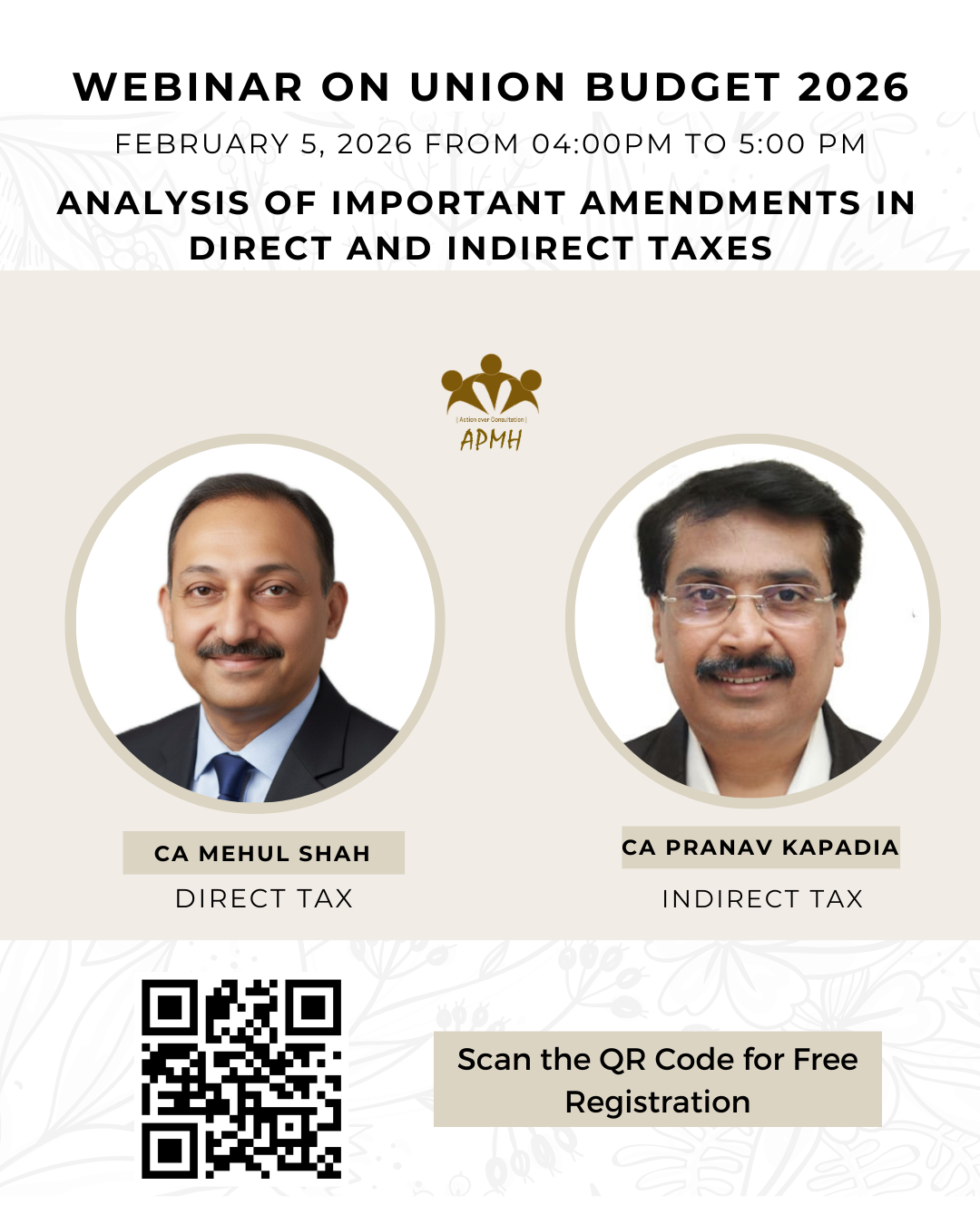
Webinar: Analysis of Important amendments in Direct and Indirect Taxes
Date: February 5, 2026
Time: 4:00 PM - 5:00 PM
Presenter: CA Mehul Shah & CA Pranav Kapadia
Register Now: Click here to Register
You will receive the link on the email id mentioned at the time of above registration.
Pls inform in case it is not received. Also pls check your spam/updates folder for the link.
Looking forward to your presence in the Webinars.
Regards,
Team APMH